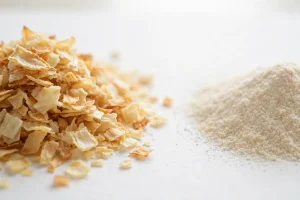
If your buying brief already says dehydrated onion, the next decision is format — flakes, granules, or powder. Three different products, not three names for one: the wrong choice shows up as visible pieces in a sauce that should be smooth, or flavor that never distributes through a dry blend. Unlike garlic, which is bought mostly for dry blending, onion serves two jobs — pieces that rehydrate in liquid, and flavor that disappears into a dry mix. Start from what your process needs the onion to do.
Start with the texture required in your process
Decide what the finished product should show before comparing offers. Three textures cover nearly every food-production use:
- Visible pieces — toppings, seasoning mixes, and prepared meals where onion should be seen as well as tasted. Flakes are the format for this job.
- Even rehydration in liquid — soups, sauces, and dressings, where small uniform pieces soften faster and more evenly. This is the job for granules or minced cuts: rehydration behavior is part of the specification.
- Invisible dispersion — dry seasoning blends, instant soups, and breadings, where onion must dose uniformly and leave no visible trace. Powder is the format for this job.
Name the texture on your inquiry. A supplier cannot quote the right format from “dehydrated onion” alone.
Compare the formats actually available
| Form | What it is | Where it works | Watch out for |
|---|---|---|---|
| Flakes | Sliced pieces of dried onion | Mixes, toppings, prepared foods where onion should be seen as well as tasted | Agree the acceptable fines level before ordering |
| Granules / minced | Dried onion cut or ground to a defined particle size | Soups, sauces, dressings where faster, even rehydration matters | One supplier’s “minced” is another’s “granules” — buy the particle size on the spec sheet, not the name |
| Powder | Fine grind for uniform dispersion | Dry seasoning blends, instant soups, breadings | Picks up moisture and clumps; not interchangeable by weight with coarser forms |
Format words are not standardized across the trade. Our own dehydrated onion range lists flakes, minced, and powder, while many buyers ask for “granules” — confirm the actual particle size with its sieve standard before comparing two offers.
Ask for particle size and ingredient specifications
“Mesh” is a sieve count, not a universal millimeter value — different sieve standards assign different openings to the same mesh number. A mesh figure quoted without its standard cannot be compared across suppliers. Before comparing offers, ask for four things: the target mesh or size range, the sieve standard it was tested against, the tolerance around that range, and the oversize/undersize allowance. A wide distribution rehydrates and flows differently from a tight one even at the same nominal size.
Then confirm what is in the bag. Dehydrated onion for food manufacturing is expected to be onion and nothing else — confirm it: ask whether any carrier, anti-caking agent, or preservative is used, and have the answer stated on the specification sheet. Request the sheet before volume commitment and check it covers: exact form; particle size with sieve standard and tolerance; moisture level; onion color or variety; foreign-matter limits; microbiological criteria; packing with moisture protection for sea freight; shelf life and storage; and whether a certificate of analysis ships with each lot.
Two questions separate a usable quotation from a vague one: which application the specification was written for, and whether the packing matches the form. For wholesale inquiries, keep “bulk” in its trade sense — confirmed particle size plus ton bags or cartons — with packing stated explicitly on the quotation.
Record your rehydration or dry-mix trial
Specification sheets make offers comparable; a trial in your own process proves them. We publish no fixed rehydration ratio, soak time, or shelf life here — those depend on your recipe, temperature, and equipment, and any fixed number would be a guess. Run the trial yourself and record it: for liquid applications, soak the sample in your actual recipe liquid at your process temperature, noting the ratio, time to full softness, and flavor strength; for dry mixes, run it through your dosing equipment and disperse it in your actual matrix; store it under your warehouse conditions to check moisture pickup, especially for powder.
Record the specification the sample was made to, and require the volume shipment to match it. Compare final offers field by field on the specification sheet, not on headline price: the cheapest offer with unstated size, moisture, and packing is not comparable to a complete one, and that gap is where most dehydrated-onion disputes start.
Ask for the dehydrated onion specification that matches your production process — target format, particle size with sieve standard, packing, quantity, destination market, and target delivery time. To compare it against the rest of the dried range, browse dehydrated vegetables.