Why Carrots Reward a Careful Check
Carrots are a workhorse ingredient for food manufacturers: they appear in soups, ready meals, mixed vegetable blends, and side dishes, and buyers expect them to look bright, cook evenly, and behave predictably on the line. Because carrots are usually bought cut rather than whole, small differences in cut, colour, and freezing quality show up quickly in the finished dish. That is why individually quick frozen (IQF) carrots deserve a closer check before a buyer commits to a season’s volume.
IQF freezing freezes each piece separately, so the product stays loose in the bag rather than forming a solid block. Good IQF carrots should pour freely, keep an even orange colour, and cook to a consistent texture.
1. Cut Style: Match the Cut to the Application
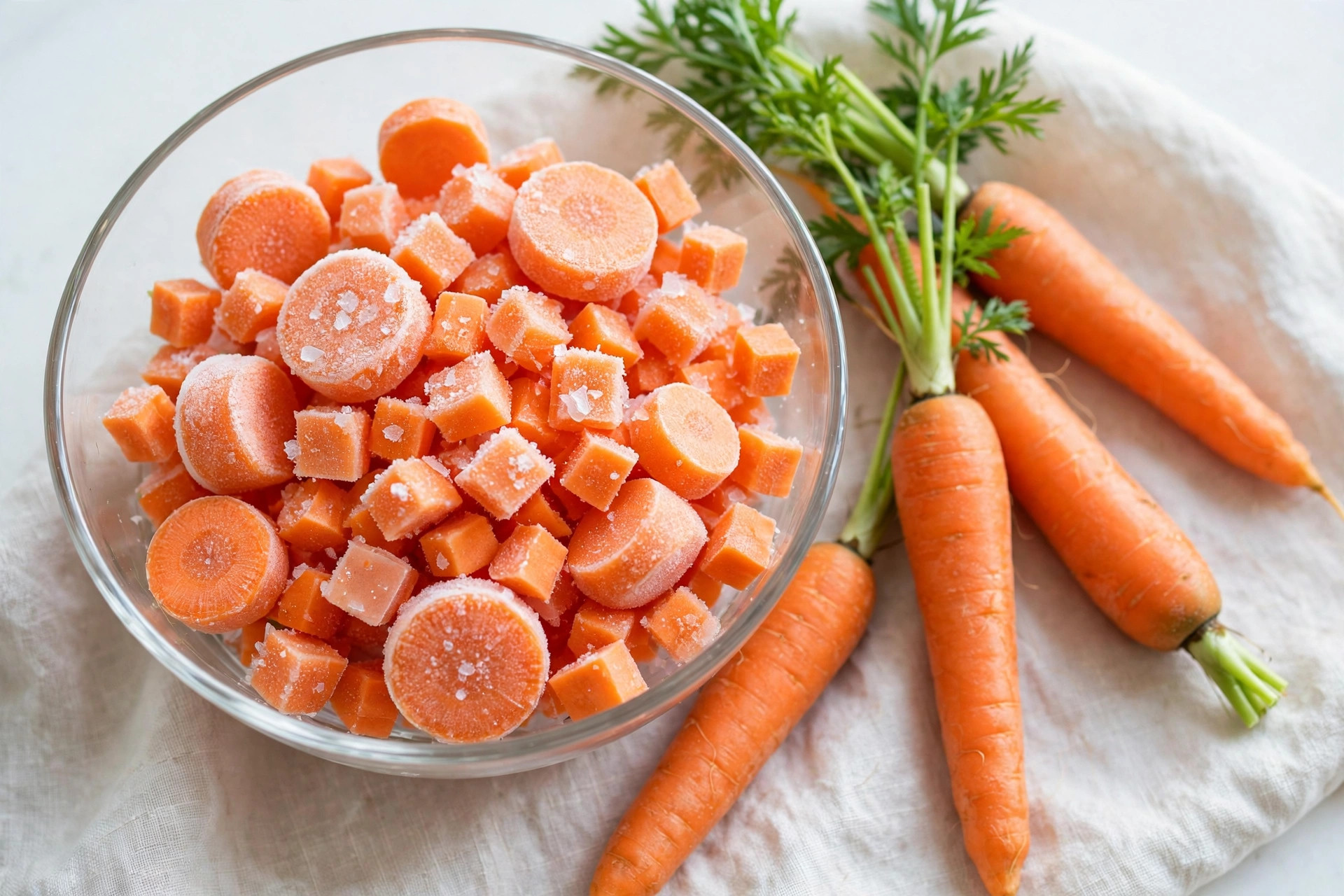
Start with the cut. Sliced carrots, often called coins, suit soups and ready meals where a visible round slice matters. Diced carrots work better in mixed blends, fillings, and sauces, where even distribution counts more than appearance.
When reviewing a sample, check that the pieces in one bag are reasonably uniform. A wide mix of thick and thin pieces will cook unevenly: thin pieces soften while thick pieces stay firm. Ask the supplier to confirm, in writing, which cut styles are offered and how cut uniformity is checked before packing.
2. Colour: Even Orange, Without Dull or Pale Pieces
Colour is the first thing a buyer notices, and it is also a useful quality signal. Good IQF carrots have an even, bright orange colour across the bag. A high share of pale, dull, or unevenly coloured pieces can make a finished dish look tired.
Check more than one bag from a sample lot, and cook a small portion the way your customers will use it. Colour that looks even when frozen but turns patchy after cooking is worth raising with the supplier before ordering.
3. Free-Flowing Quality and the Cold Chain
The simplest IQF test needs no equipment. Pour a frozen sample from the bag: the pieces should flow freely, with only light frost on the surface. Large ice clumps or pieces stuck together in sheets usually point to temperature fluctuation during storage or transport, not to the carrots themselves.
That is why the cold chain matters as much as the product. Ask how the product is handled from freezing through loading, and confirm that storage and transport temperatures are kept steady and documented. For Smiler Food’s range, see our IQF carrot product page for the product format and enquiry route.
4. Texture and Taste After Cooking
Frozen carrots are judged after cooking, not straight from the bag. Cook a sample without over-seasoning it, and check tenderness, sweetness, and whether the pieces hold their shape. Test the carrots in their intended application — a soup, a ready meal, or a mixed blend — rather than only on their own.
5. A Short Checklist Before You Order
Before ordering, lock these points down in writing: cut style and uniformity, colour standard, free-flowing condition on arrival, packing format, labelling, and cold chain documentation. Keep a retained sample for comparison when the shipment arrives.
IQF carrots look simple, but they reward buyers who check the details. A cut matched to the dish, even colour, free-flowing bags, and a steady cold chain are the signs that a supplier’s product will perform consistently.
To discuss IQF carrots for your range, contact Smiler Food at [email protected] or via WhatsApp on +86 155 8883 1399.