Why cauliflower rewards careful checking
IQF cauliflower is a practical ingredient for foodservice kitchens, ready-meal lines and retail packs: the florets cook quickly, portion easily and hold their shape well when handled properly. The risk for buyers is variation between lots. Florets that differ in size cook unevenly, colour that drifts from creamy white to yellow suggests ageing or poor handling, and bags that arrive as a solid block defeat the whole point of individually quick frozen product. Checking before ordering in volume saves rework later.
Floret size and uniformity
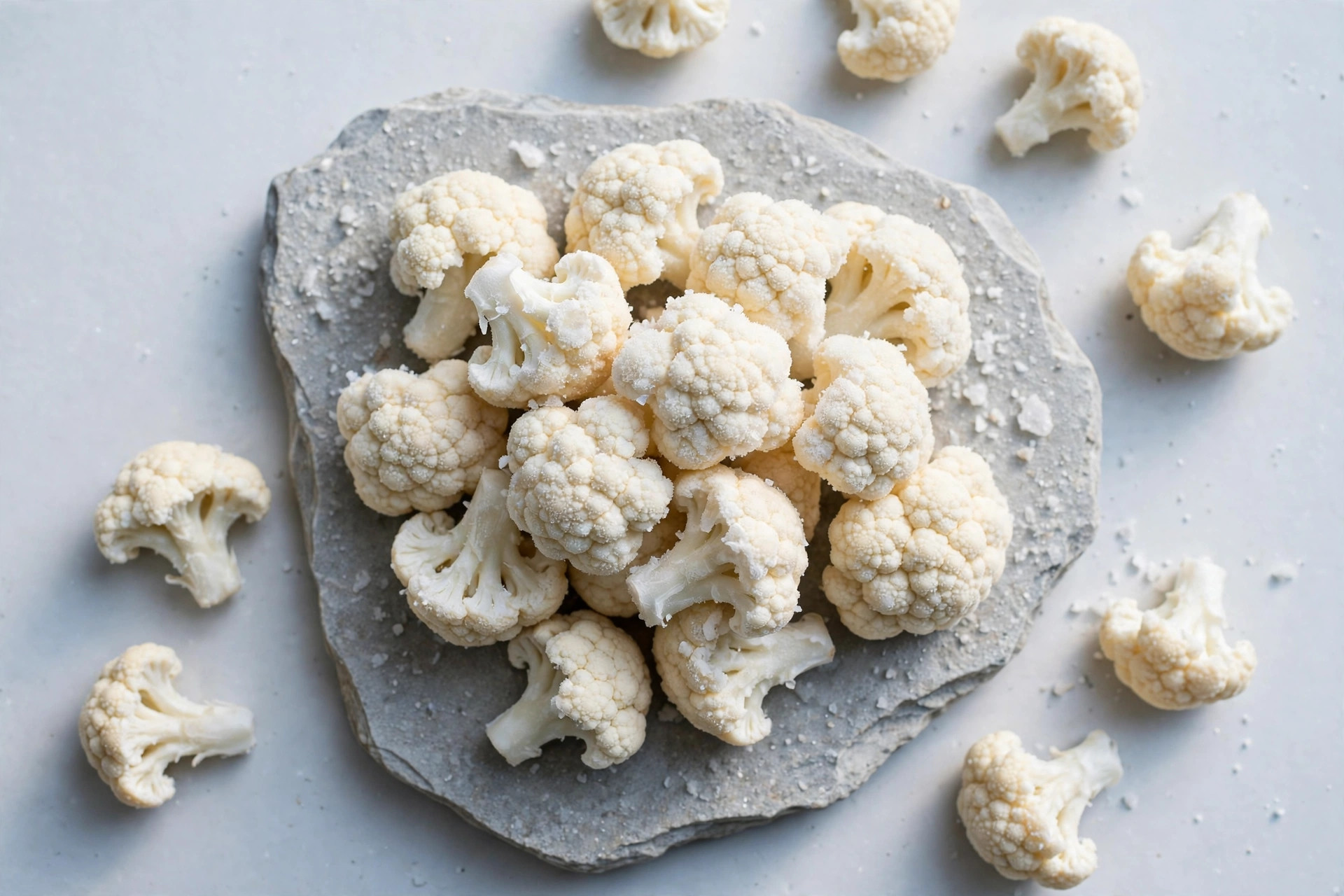
Start with size. Uniform florets cook at the same rate, so a tray does not end up half soft and half firm. Ask the supplier how florets are graded and what happens to very small pieces and crumbs: a lot with a high share of small fragments looks untidy on the plate and behaves differently in a sauce or a roast tray. Look at a sample spread out rather than in a pile, so oversized heads and tiny pieces are both visible. Agree the size description in words and keep a reference sample from the approved lot, so later deliveries can be compared against something concrete.
Colour: creamy white, not yellowed
Colour is the fastest quality signal in cauliflower. Good IQF cauliflower is creamy white, with no yellowing, browning or dark spots on the curd. Discolouration can come from age, sun exposure before processing or damage during handling, and it rarely improves in cooking. Check colour after cooking as well as straight from the bag: a floret that looks acceptable frozen but greys or yellows in the pan will disappoint the end customer.
Free-flow: the defining IQF test
The defining test of any IQF product is simple: pour the bag and see whether the pieces separate. Florets should flow freely and be easy to portion, with no large frozen block and no heavy ice clumps binding pieces together. Clumping often points to temperature fluctuation somewhere in the chain, which also shortens shelf life and damages texture. A bag that has clearly thawed and refrozen should be raised with the supplier rather than accepted quietly.
Stem, trim and usable yield
Stem proportion matters more than buyers sometimes expect. A floret with a long, thick stem looks generous in the bag but gives less usable curd per kilo after trimming, and it cooks at a different rate from the head. Check the trim: stems should be cut cleanly and consistently, without woody or damaged ends.
Cold chain and packing
None of the checks above mean much if the cold chain breaks. Ask how the product is kept frozen from packing to loading, and inspect the packing on arrival: bags should be sealed and intact, with no signs of thawing, moisture damage or crushed contents. Clear labelling makes traceability straightforward if a question arises later. For a first order, a smaller trial lot lets you run every check above on the actual product before committing to volume.
Putting it in writing
Before placing a bulk order, put the agreed points in the purchase specification: floret size description, colour standard, free-flow requirement, stem trim, packing format and labelling. A reference sample, a photo record and a short note of what was checked turn a general promise of quality into something both sides can verify. Buyers who do this work once usually find later orders run far more smoothly.
Smiler Food supplies IQF cauliflower alongside a wider range of IQF frozen vegetables for food manufacturers and distributors. For product details, samples and quotations, contact us at [email protected] or via WhatsApp at +86 155 8883 1399.