Why Green Beans Reward a Closer Look Before You Buy
Green beans look simple on a spec sheet, yet they are one of the products where small differences show up quickly in a finished dish. Cut length, colour, and free-flow behaviour all affect portioning, cooking time, and plate appearance. For buyers sourcing IQF green beans from China, a short checklist before ordering helps avoid surprises when the container arrives.
The checks below focus on what to ask for and what to look at in a sample. Ask the supplier to confirm each point against its own specification sheet before you commit.
1. Cut Length and Uniformity
Start with cut length. Beans cut to a consistent length cook more evenly and portion more predictably, whether they are served whole as a side or cut further in processing. Mixed lengths in one bag can mean some pieces turn soft while others are still firm.
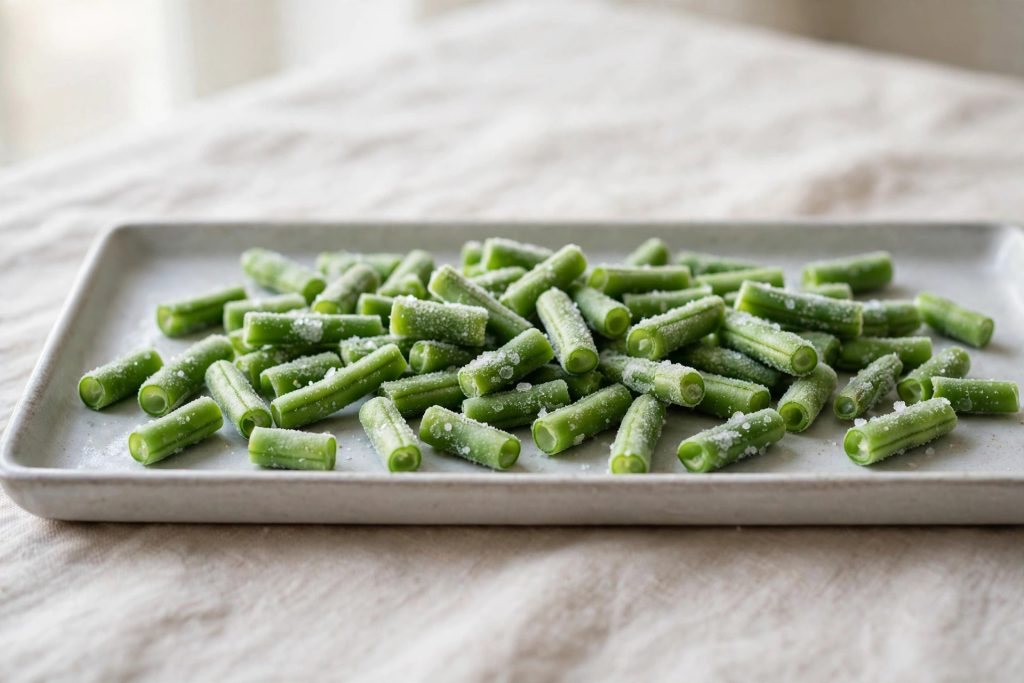
Ask the supplier what cut lengths it offers and how it controls variation within a batch. In a sample, spread a portion on a tray and look for short fragments, overlong pieces, and uneven ends.
2. Colour and Appearance
Colour is the first quality signal a buyer sees when a bag is opened. Fresh, evenly green beans suggest careful selection and handling; dull, yellowed, or blotchy pieces point to maturity differences or handling problems upstream.
Check colour across the whole sample, not just the top layer. Look for broken tips, stem ends, and foreign matter at the same time. Photographs can flatter a product, so a physical sample remains the most reliable check.
3. Free-Flow Behaviour After Freezing
Individually quick frozen beans should pour freely from the bag instead of arriving as a solid block. Clumping usually signals temperature abuse somewhere in the chain, or excess surface moisture before freezing.
Test this in the sample: pour the beans from the bag and see whether they separate easily. Pieces that stay stuck together after gentle handling deserve a question about cold chain control. Ask the supplier how it monitors temperature from freezing through loading, and what records it can share for a shipment.
4. Texture After Cooking
Green beans are judged on the plate, so cook the sample the way your customers will. Over-blanched beans go soft; under-blanched beans can taste raw and lose colour quickly. The right balance keeps a slight bite and a bright green colour after cooking and holding.
Run the sample through your own kitchen test rather than relying on a description alone.
5. Packaging, Labelling, and Documentation
Confirm packaging format, bag or carton size, and labelling before ordering, since these affect storage, handling, and your own repacking. Check that the product name, origin, and storage instructions on the label match what was agreed.
Ask what documents accompany a shipment, such as a specification sheet and any test reports the supplier provides on request. Agree in writing which documents are supplied with each order, so there is no gap between a sales promise and the paperwork that arrives with the goods.
A Practical Ordering Sequence
A workable sequence is: agree the specification in writing, test a sample against it, confirm packaging and documents, then place the first order at a volume you can inspect on arrival. Inspect the first delivery against the retained sample, and raise any mismatch promptly while the shipment is still traceable.
Smiler Food supplies IQF frozen vegetables, including green beans, to food manufacturers and distributors. To discuss specifications, samples, and current availability, contact us at [email protected] or via WhatsApp at +86 155 8883 1399.