By Smiler Food
Mango is one of the most forgiving fruits to freeze and one of the easiest to buy badly. A golden dice that looks perfect in the carton can still disappoint once it is blended, heated, or folded into a dessert — which is why buyers who source IQF mango from China check the fruit against their finished recipe, not against a photograph.
Halves or dice: match the cut to the recipe
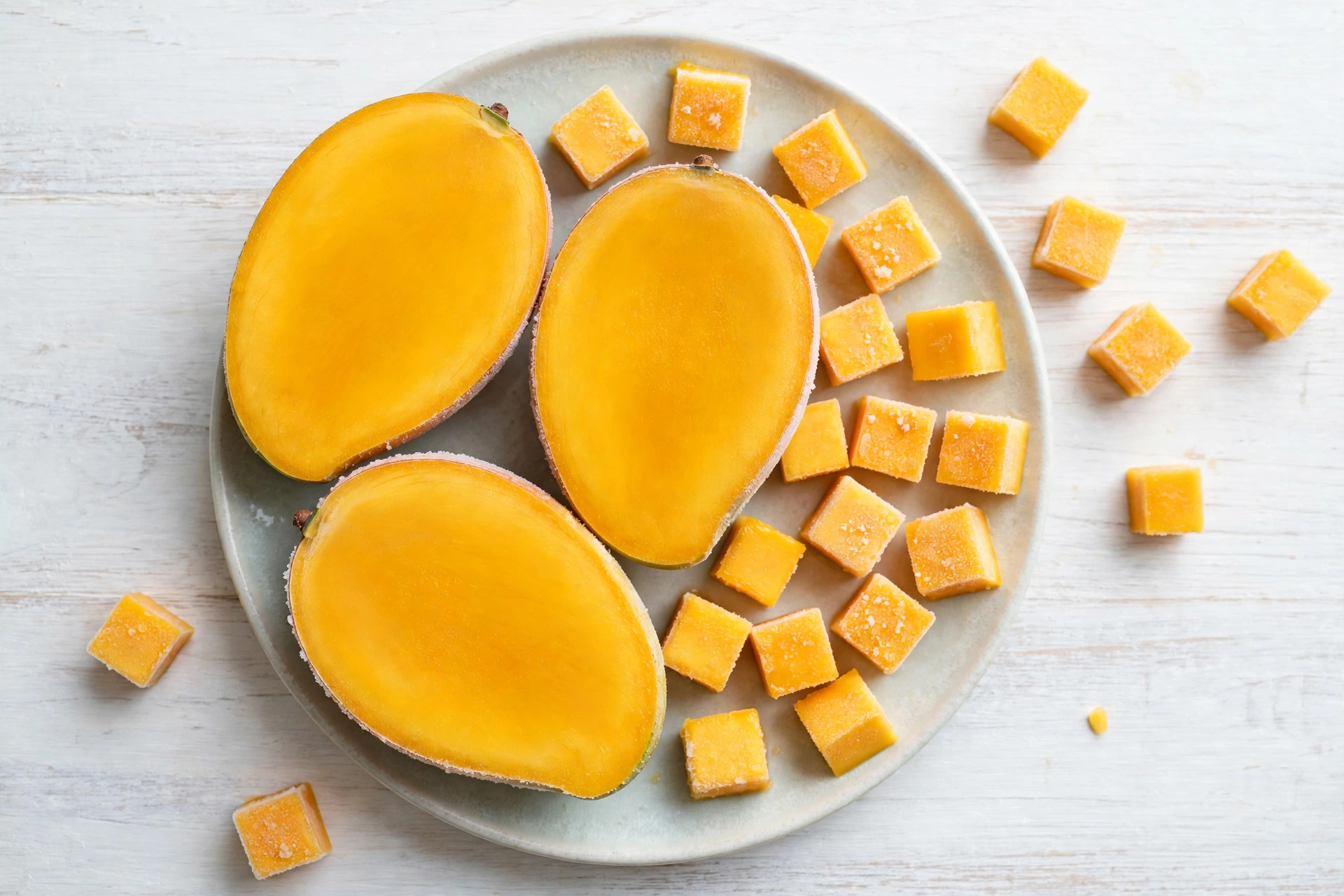
IQF mango is supplied as peeled halves or as 20 x 20 mm dice, and the two formats serve different lines. Diced mango suits smoothies, sorbet, and fruit preparations, where even pieces blend predictably and portion control is simple. Peeled halves suit processors who cut to their own specification, or who want visible pieces in a dessert.
Before asking for a price, agree the cut, the dimensions, and the acceptable range for off-size pieces in writing, confirmed against the approved sample. A tolerance for the third dimension of diced fruit should be agreed too, since a dice that is thin in one direction behaves differently in a blender from a true cube.
Variety, ripeness, and sweetness
Variety and ripeness decide flavour more than any other factor, so confirm the cultivar where it affects taste, texture, or processing performance. Agree the sweetness and acidity profile your recipe needs, and request Brix and acidity results if they matter for formulation.
Colour should be checked in the finished recipe rather than in the frozen carton alone. Compare colour after thawing and after the blending or heating step your line uses, and ask for even, golden colour with no pale or brown patches. Evaluate a sample in your own process, with your end use and target specification attached.
Drained weight and thawing loss
Count and weigh a thawed sample: drained weight and thawing loss tell you how much fruit actually reaches the finished product, so test with the method from your own production line. Texture after thawing matters too.
The same checks apply to the other frozen fruits buyers often order alongside mango. IQF banana is a common smoothie base, IQF passion fruit pulp adds acidity to drinks and sorbet, and IQF blackcurrant brings colour and tartness to mixed-berry lines. Confirm each one against its own sample rather than assuming a supplier’s mango standard carries over.
Free-flow, packing, and cold chain
Well-frozen IQF mango should pour freely from the pack without large frozen clumps. Clumping can point to temperature abuse during storage or transport, so check that the packs arrive solidly frozen and that the cold chain has been kept unbroken. Keep the product frozen through storage and transport, and follow the temperature and shelf-life instructions on the agreed specification.
Packing is offered in 10 kg bulk packs, with inner pack and carton confirmed in the quotation. An indicative minimum order of 12 metric tonnes applies to private-label orders as a reference; standard bulk or trial quantities are quoted separately. Tell the supplier the net weight per inner pack, packs per carton, estimated order quantity, and destination country or port, and include pallet, label, and delivery-window requirements where relevant.
Ask for the agreed product specification, ingredients and allergen information, and the quality documents relevant to your market before ordering, and agree the acceptance criteria and relevant batch documents in advance. A sample tested in your own recipe is still the cheapest check available — it answers the questions no photograph can.
To request a sample or a quotation for IQF mango, contact Smiler Food at [email protected] or on WhatsApp at +86 155 8883 1399.